
Just because you're part of a team doesn't mean you have to get fully equipped with all sorts of gear. Organizing a team of airsoft players is relatively simple, if you focus on a few key things: organizing communication within the team, distributing tasks and ensuring everyone has all the information they need about the equipment they use to play airsoft. Focus on quality, safety and your preferred way of playing and that's it.
Setting Team Standards for Gear
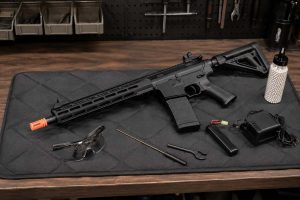
It is very important that before you start shopping for Airsoft equipment as a team you should have a meeting or discussion to determine what your needs are for the essential gear that each team member will require for each game. Also, which equipment can be shared, and which will be individual choices. This can include safety equipment (applicable eye and face protection, safe footwear, hydration etc.), a method to carry ammunition, and additional items to assist your gameplay and field play. In addition, it would be good to establish any visual identifiers needed for team recognition.
By establishing what players need before they start shopping for airsoft gear, airsoft teams can avoid excessive spending. While each player can choose his or her own guns, such as a compact airsoft rifle or a sidearm, the shared expectations for the team's communication, safety, and check of equipment is much more important.
Document the team's basic equipment needs with a check list, listing the required items.
Tailor Gear to Fit the Gameplay and Location
This list should be made with the unique gameplay of your team and the unique features of the various fields you will be playing at in mind. So a team that plays a lot of indoor games may want to consider more compact gear and a team that plays a lot of outdoor games may want to consider more gear for hydration, etc. Also take into consideration the size of the field, game type and distance of games.
Assign roles with the types of games and venues in mind too. In very close, indoors games a unit style of play may be better. Larger outdoor games with many objectives may have pairs of players assigned to specific objectives. Also consider whether the other team members will be able to carry additional gear such as more ammo or support equipment for the objective players.
Do not assign roles because they will be most effective on the field. Players must have a lot of fun playing with their Airsoft guns. Roles assigned for reasons of effectiveness can become very cumbersome very quickly.
Prioritize Reliability and Safety in Equipment
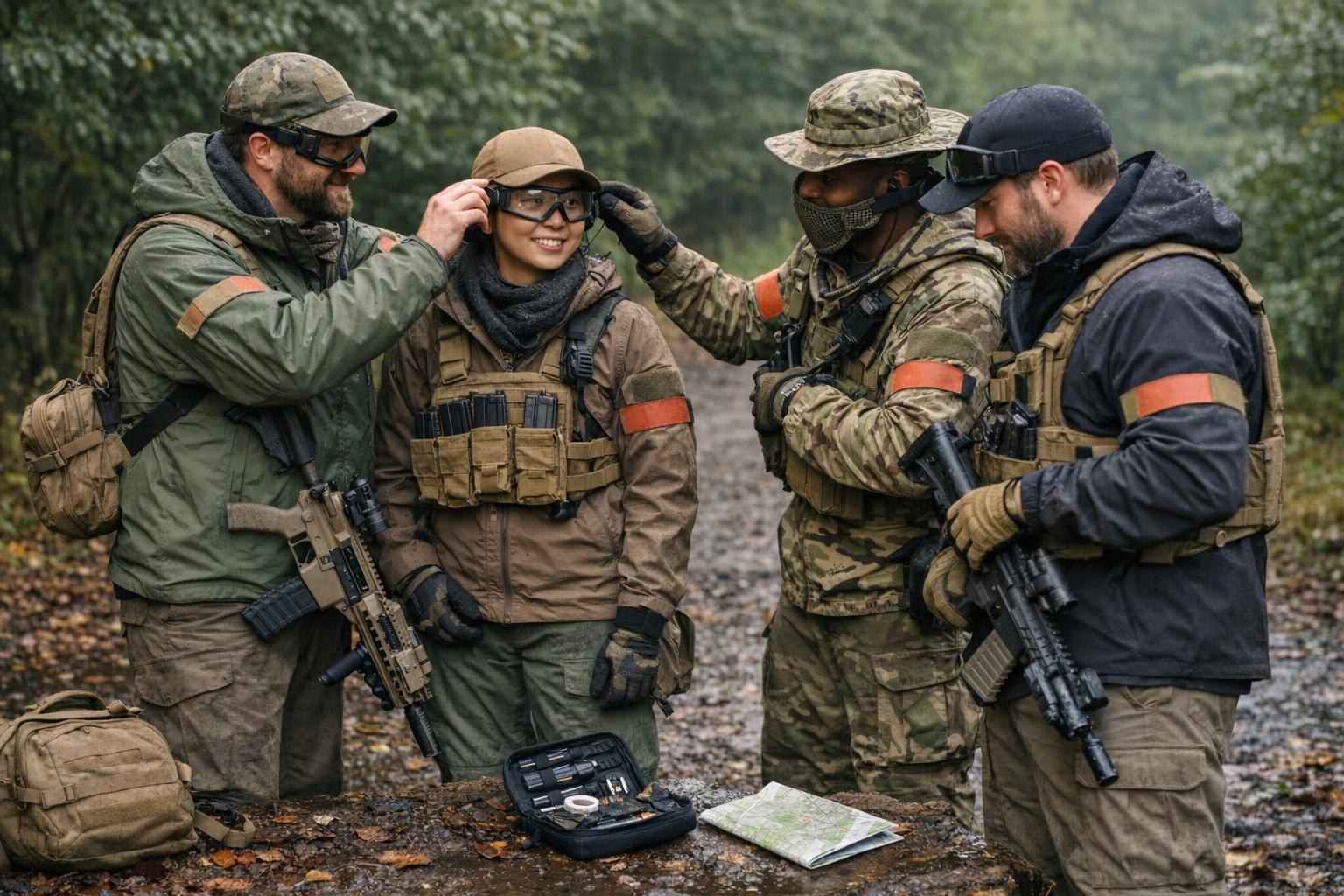
Reliability and Safety first! Before looking at all other aspects of the team's equipment make sure each player's basic safety gear is of good quality. This means that all players must have eye protection (which must comply with the field's safety requirements and fit well) and face protection etc. as well as suitable clothing and footwear. Remember to check the current safety requirements for all safety equipment.
Keep a check on your safety equipment too for maintenance. Take a few minutes to test out the eye protection, face mask, and clothing etc before each match. Also, consider what spare parts you need to take with you, and where you can put them in your repair pouch. It is better to take fewer, more essential parts with you to avoid excess weight and a mass of random spare parts.
However, be careful not to stock up on lots of cheap equipment, even if they seem to do the same job. Excess gear adds weight and could cause more problems than benefits in terms of your comfort on the field.
Find Balance Between Aesthetic and Functional Gear
Should you pick a uniform outfit for all of your players or choose compatible gear instead? Choosing matching loadouts can really add to your team's identity. However, it might mean that each player is stuck wearing very expensive and restrictive versions of equipment that they already own and are satisfied with. Instead, a common color palette or arm markers can really make for some great and simple identifiers for your team on the field.
Uniform matching to visualize the identity of your group might be useful if you play in official matches. But mostly players already have the required gear, and field rules can be totally different on other fields. So you just pick a simple color scheme and mark your arm with simple markers.
We choose visual identifiers which are easily seen from a distance. They must be clearly distinguishable from any safety signals as well as from those used by opposing teams. What to choose will depend on what is allowed on the venues where you will be playing and what has already been agreed upon by other airsofters.
Build Team Roles Around Individual Strengths
Individual strengths should be utilized when delegating tasks and responsibilities within an airsoft team. This does not have to mean everyone has a formal role like radio man, objective man, or maintenance man for instance but can simply be duties that need to be performed by members of the group, that the individual is best suited for, or even that they simply enjoy doing.
When moving around the field it is a good idea to restrict your radio communication to a few simple phrases to let other team members know what you are doing. These might be to regroup, to pause for a moment or to let others know that you have been 'taken out' of the game. It is easy to get caught up in chatting on the radio, but in the heat of the game this can create more problems than it is worth.
Assign responsibilities for a time frame and then swap them up so that each player will have held all of the crucial knowledge and skills to contribute to the team.
Practice Team Coordination with Flexibility
A 10 minute briefing prior to each match is far more effective than rigidly adhering to a pre-planned strategy. Agree on your objectives for the match, the area you will be playing within and your respective boundaries. Pick a central point for the team to regroup at should things start to go wrong and most importantly of all, agree upon clear and concise communication prior to the game.
When running to objectives remember to include the slowest member of your team and maintain formation to ensure you are all aware of each other's whereabouts. Have a few predetermined safe routes to and from the engagement area and make sure to follow the rules of the field as well as local laws and to respect other players.
At the end of each game, have the team reflect on one thing that they could improve. See if there are any issues with equipment or communication that may have hindered the team. Do not purchase equipment looking for ways to improve because often those items will not aid in overall team improvement.
Evaluate Gear after Gameplay Experience
Instead, you want to see how equipment really works after a few games of airsoft. Does that cool new pouch really work for you when you need to access it in a hurry? Does your outfit match that of your team members even though it is not very comfortable for you to wear during the games?
In making a purchase as part of the team's overall gear, make a list of needed items and rank them in order of safest, most reliable, most practical, and most comfortable. Don't substitute a player's working perfectly well piece of personal gear for a 'matching' piece that does not work as well for that player.
Your cohesive small team runs on shared methods of play, ways of communicating, and hopefully a good amount of practice and pre-game maintenance. They provide far more benefit than a matching loadout.